DMX is a digital communication protocol that lets one controller send precise instructions to hundreds of lighting fixtures at once. It is the backbone of dynamic lighting in concert venues, casinos, theaters, airports, and any public space where color, movement, and timing matter as much as illumination.
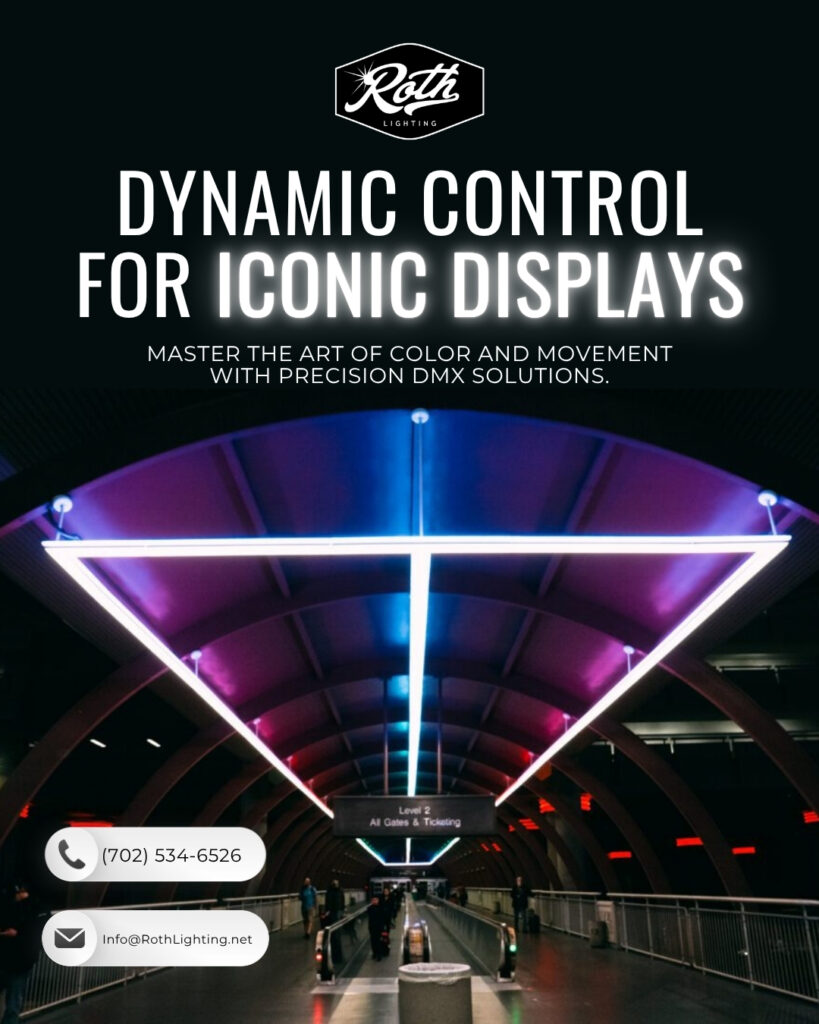
If you have ever walked through the colorful tunnel that connects Terminal 1 at Harry Reid International Airport in Las Vegas, you have experienced DMX in action. That project, completed by our team at Roth Lighting in partnership with Nedco and Utopia Lighting, is a working demonstration of what DMX makes possible in a commercial environment.
This guide walks through what DMX is, how it works, where it belongs in a project, and how we approached the Las Vegas Airport build from concept to commissioning.
What does DMX stand for in lighting?
DMX stands for Digital Multiplex. The full name of the standard is DMX512, where 512 refers to the number of individual channels a single DMX universe can address. It was originally developed in 1986 by the United States Institute for Theatre Technology and is now maintained as ANSI standard E1.11 by ESTA.
Each channel can carry a value between 0 and 255. That means a single DMX network can independently control the intensity, color mixing, motion, or any other addressable parameter of up to 512 separate lighting attributes in real time.
How does DMX lighting control work?
A DMX system has three parts working together:
- The controller, which sends commands. This is often a lighting console, a software interface, or a dedicated DMX controller programmed for a specific show or schedule.
- The data network, which carries DMX signals over five-wire or three-wire cable, typically using XLR connectors.
- The fixtures or drivers, which receive the data and respond. Each fixture is assigned a starting channel address, and it listens for instructions on its assigned range.
When a designer programs a scene, the controller sends a continuous stream of 512 channel values per universe at roughly 44 packets per second. Every fixture in the network reads only its addressed channels and updates instantly. This is what allows precisely synchronized color changes, chase patterns, and timed animations across an entire installation.
For larger projects, multiple universes are linked together. The Las Vegas Airport walkway uses several universes to drive its color-changing side panels and white overhead light separately.
When should you use DMX over DALI or 0-10V controls?
This is one of the most common questions specifiers ask. The right protocol depends entirely on what the lighting needs to do.
Protocol Comparison at a Glance
Choosing the Right Control System
| Protocol | Best For | Typical Applications |
|---|---|---|
| DMXShow & Experience | Dynamic color, animation, timed scenes | Theatrical and brand-driven spaces Show-style programming for venues Large RGB / RGBW fixture arrays |
| DALIEnergy & Intelligence | Energy management and daylight harvesting | Office, healthcare, institutional spaces Scheduled dimming and occupancy response Two-way fixture monitoring and reporting |
| 0-10VSimple & Cost-Effective | Basic dimming, no advanced features | Cost-constrained installations Small fixture count, simple zoning Quick retrofits of legacy systems |
Many commercial projects use a combination. A casino might run DALI for back-of-house energy compliance and DMX for the gaming floor and signage. A hotel might use 0-10V in guest rooms and DMX in the lobby. The right specifier evaluates each zone on its own merits.
Our in-house controls team can walk you through DMX, DALI, 0–10V, and
hybrid system options during a no-cost site survey across Southern Nevada,
Northern Nevada, and Western Arizona.
Case study: How Roth Lighting reimagined the Las Vegas Airport T1 walkway
The T1 walkway tunnel at Harry Reid International Airport is one of the first impressions millions of visitors form of Las Vegas every year. The previous lighting installation had served the airport well, but it was aging, increasingly difficult for facilities staff to maintain, and no longer matched the airport’s reimaging vision.
The challenge: Replace the existing system without
losing the colored lighting feel that travelers had come to associate
with the space, while introducing modern control flexibility and
reducing long-term maintenance burden.
The collaboration: Roth Lighting was contacted by
Nedco and the airport team. From there, the creative direction expanded
quickly. The airport wanted dynamic capability. Our team wanted a
fixture and control architecture that would last.
The solution: We worked with Utopia Lighting in
California to develop a custom DMX fixture purpose-built for the
walkway. Roth Lighting designed the lighting control system that
drives it.
The result has two independent DMX-controlled layers:
- Color-changing animated side panels that can run programmed scenes, slow ambient washes, or branded color sequences
- DMX-controlled white light that washes the walkway floor and provides functional illumination at the correct levels for an airport corridor
The two layers run on separate channels within the same control network. That means airport operations can adjust the colored ambience independently from the working light, and program scenes that respond to time of day, holidays, or special events without ever compromising visibility.
Because Roth Lighting holds Nevada Electrical License #0086605 and operates an in-house controls team of programmers, electricians, and commissioning technicians, the full path from concept to operation stayed under one roof. That continuity matters on a public infrastructure project where downtime is not an option.
See the full project gallery on the
Las Vegas Airport project page
.
Where DMX lighting belongs in commercial projects
DMX is purpose-built for spaces where lighting is part of the experience, not just the infrastructure. We see it deliver value in:
- Airports, transit hubs, and wayfinding tunnels, where dynamic light shapes how travelers move through the space
- Casinos and gaming floors, where coordinated color and movement reinforce energy and brand identity
- Hotel lobbies, ballrooms, and entertainment venues, where scene control matters for events and atmosphere
- Architectural facades and exterior signage, where time-based programming brings buildings to life after dark
- Retail flagships and themed environments, where lighting and brand identity are inseparable
- Theaters, performance halls, and houses of worship, where show control has been the original home of DMX since 1986
If a project’s lighting needs to do anything more than turn on, dim, and turn off, DMX is worth evaluating.
How do you choose the right DMX controller and fixtures?
Picking the right hardware comes down to four questions:
- How many addressable channels does the project need across all universes? This drives the controller class and network design.
- Will the system need to integrate with other building systems like audio-visual, building management, or audience triggers? Integration capability separates entry-level controllers from professional show controllers.
- Who will operate it day-to-day? Facility staff need different interfaces than touring technicians. A casino operations team needs scheduled scenes, not a console.
- What level of redundancy is required? Public-facing installations like airports often need backup controllers and failover logic that simpler venues do not.
For projects in Southern Nevada, Northern Nevada, and Western Arizona, our team can walk a specifier through these decisions during a site survey, recommend fixture and controller combinations from the manufacturers we represent on our Southern Nevada line card and Northern Nevada line card, and design the control architecture from the ground up.
Why work with a local DMX specialist in Nevada
DMX is unforgiving when it is specified incorrectly. Universe limits, addressing conflicts, cable runs, and termination errors are easy to overlook on paper and expensive to fix once a project is energized. The difference between a system that delights occupants for a decade and one that requires constant intervention is almost always the depth of the design and commissioning work that happened before installation.
Roth Lighting represents more than 60 lighting and controls manufacturers and has been designing and commissioning systems for Nevada’s commercial, industrial, and hospitality markets for years. Projects in our portfolio include the Las Vegas Airport, Mandalay Bay Ballroom, the UNLV Thomas and Mack Center, Planet 13, Summerlin Village Center, and the Raiders Hall of Fame.
Among the lighting control lines relevant to dynamic projects like this one, we represent Dynalite, WattStopper, Casambi, Signify Interact, Color Kinetics, and Vari-Lite.
If you are evaluating DMX lighting controls for a project in Nevada or Western Arizona, we can help you map the right fixtures and controllers to your application, design the network, and commission the install through our in-house team.